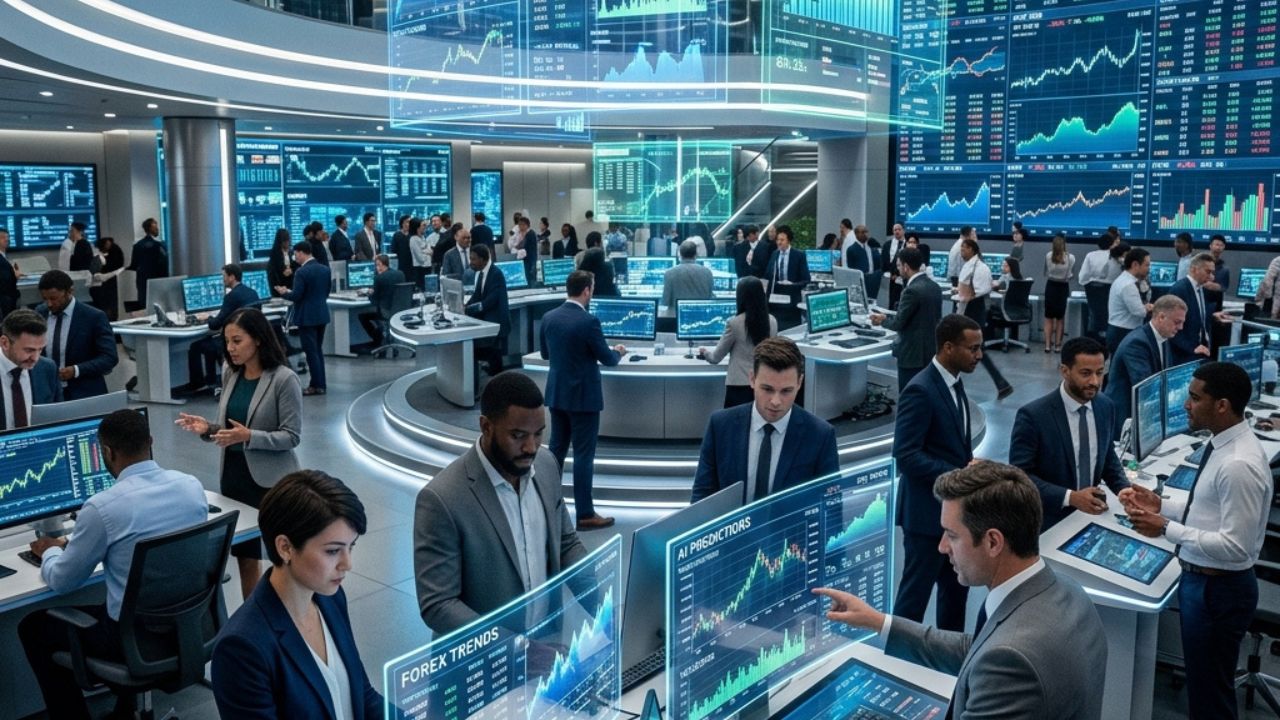
AI-powered investing uses machine learning, predictive algorithms, and automated trading systems to analyze markets, execute trades, and manage risk faster and more accurately than human traders. Forex and stock market investors are adopting AI tools to remove emotional bias, process vast datasets in real time, and identify profitable opportunities across multiple asset classes simultaneously.
The financial markets have always rewarded those who can process information faster than the competition. For decades, that advantage belonged to institutional investors with armies of analysts, proprietary data feeds, and sophisticated trading desks. Now, AI is redistributing that edge—putting institutional-grade analytical power into the hands of individual traders and smaller investment firms.
AI-powered investing refers to the use of machine learning, natural language processing, neural networks, and algorithmic systems to analyze financial markets, generate trade signals, and execute investment decisions. These technologies don’t just automate existing processes—they uncover patterns and correlations that human analysts would never detect, working across millions of data points simultaneously.
Forex and stock market traders are paying close attention. The global forex market processes over $7.5 trillion in daily transactions (according to the Bank for International Settlements, 2022), generating a volume of data no human team could reasonably analyze in real time. The stock market isn’t far behind, with thousands of publicly listed companies producing earnings reports, news releases, and price movements every trading session.
This post breaks down exactly how AI is changing the game in both forex and equity markets, what specific applications traders are using today, and the key benefits and limitations every investor should understand before integrating AI into their strategy.
How Is AI Transforming Forex Trading?
Forex trading is, at its core, a data problem. Currency pairs respond to economic indicators, geopolitical events, central bank announcements, and cross-market correlations—often all at once. AI excels precisely here.
Can AI Perform Real-Time Forex Market Analysis?
Yes. Modern AI trading systems monitor currency pairs continuously, scanning for technical patterns, price anomalies, and momentum shifts across dozens of pairs in parallel. Traditional chart analysis might take a human trader hours; an AI system completes the same task in milliseconds.
Pattern recognition is a particular strength. Neural networks trained on historical forex data can identify recurring formations—head-and-shoulders patterns, flag breakouts, divergences—with a consistency and speed no human trader can match. More importantly, these systems learn from new data, refining their accuracy over time.
How Do Predictive Algorithms Identify Currency Trends?
Predictive AI models in forex analyze a combination of historical price data, macroeconomic variables, and cross-currency correlations to forecast directional bias before trends become clearly visible on a chart. Some advanced systems incorporate satellite data, shipping metrics, and commodity prices to build a more complete picture of currency-driving fundamentals.
For example, an AI model tracking the AUD/USD pair might simultaneously monitor Australian iron ore export volumes, US Federal Reserve communication patterns, and real-time positioning data from futures markets—synthesizing inputs that no individual trader could reasonably track.
What Are Automated Forex Trading Systems?
Automated trading systems—often called algorithmic trading or forex robots—execute buy and sell orders based on predefined criteria, without human intervention. Because forex markets operate 24 hours a day across global sessions (Sydney, Tokyo, London, New York), automation allows traders to capture opportunities that arise outside normal working hours.
Modern AI-driven systems go beyond simple rule-based automation. They adapt to changing market conditions, adjust position sizes dynamically, and apply machine learning to improve strategy performance over time. Platforms like MetaTrader 5, QuantConnect, and Interactive Brokers’ API infrastructure support this kind of deployment.
How Does AI Improve Risk Management in Forex Trading?
Risk management is arguably where AI delivers its most consistent value. Machine learning models continuously calculate real-time risk exposure, adjusting stop-loss levels, position sizes, and leverage ratios based on market volatility. When conditions become erratic—such as during a major central bank announcement—AI systems can reduce exposure automatically, protecting capital in ways that emotionally-driven human traders often fail to execute.
How Is AI Being Applied to Stock Market Investing?
Stock market investing involves a different but equally data-rich environment. AI applications here span from sentiment analysis to portfolio construction, giving both active traders and long-term investors a meaningful analytical edge.
How Does AI Sentiment Analysis Work in Stock Markets?
Sentiment analysis uses natural language processing to evaluate the emotional tone of text-based data—news articles, earnings call transcripts, social media posts, analyst reports, and regulatory filings. By quantifying whether market sentiment around a stock or sector is positive, negative, or neutral, AI models can anticipate price movements before they materialize in price charts.
During a quarterly earnings call, for instance, an AI sentiment tool can assess not just the numbers being reported, but how executives discuss guidance, risks, and competitive dynamics. Research published by the Journal of Financial Economics has shown that linguistic cues in earnings calls carry statistically significant predictive power for short-term stock returns.
Can AI Automate Fundamental Stock Analysis?
Screening thousands of publicly listed companies manually for investment criteria—price-to-earnings ratios, revenue growth, debt levels, return on equity—is time-consuming and inconsistent. AI-powered fundamental analysis tools automate this process, screening entire markets in seconds against customized criteria.
Platforms like Sentieo, Koyfin, and Refinitiv Eikon integrate machine learning to not only filter companies by financial metrics, but also to flag anomalies in financial statements that might indicate accounting irregularities or deteriorating business fundamentals.
How Do Neural Networks Improve Technical Analysis for Stocks?
Neural networks—a class of machine learning models designed to recognize complex, non-linear patterns—have become increasingly popular for technical analysis in equity markets. Unlike traditional technical indicators, which are rule-based and backward-looking, neural network models can identify subtle, multi-variable patterns that precede significant price moves.
Applied to entry and exit signals, this means higher accuracy on trade timing. A neural network trained on historical price, volume, and options flow data can identify conditions that have historically preceded breakouts or reversals with greater reliability than a standard moving average crossover system.
How Does AI Optimize Investment Portfolios?
Portfolio optimization has traditionally relied on Modern Portfolio Theory, developed by Harry Markowitz in 1952. AI-powered optimization goes further, dynamically balancing risk and return in response to changing market conditions, correlation shifts between assets, and evolving investor goals.
Robo-advisors like Betterment and Wealthfront already use algorithmic portfolio management for retail investors. Institutional platforms apply more sophisticated models—factor-based AI systems that dynamically tilt exposure toward momentum, value, or quality factors depending on the current market regime.
What Are the Key Benefits of AI-Powered Investing?
Removing Emotional Bias From Trading Decisions
Behavioral finance research consistently shows that human traders underperform due to cognitive biases—fear, greed, overconfidence, loss aversion. AI systems don’t experience emotions. A sell signal based on objective criteria gets executed regardless of how convincing a bull case feels in the moment. This discipline compounds over time, producing more consistent results.
Processing Data at a Scale Humans Cannot Match
The sheer volume of market-relevant data generated every trading session exceeds any human team’s capacity to analyze. AI processes earnings reports, macroeconomic releases, options flow, order book data, and news feeds simultaneously—identifying signals buried in noise that would otherwise go unnoticed.
Identifying Opportunities Across Multiple Asset Classes
AI systems aren’t limited to a single market. A well-designed investment AI can monitor forex pairs, equities, commodities, and fixed income simultaneously, flagging correlated opportunities or hedging relationships across asset classes. This multi-market awareness gives AI-assisted traders a structural advantage over those focused on a single market.
Reducing Time Spent on Manual Research
For individual investors, the time cost of thorough market research is often prohibitive. AI tools automate the screening, data aggregation, and preliminary analysis stages of investment research, freeing up investor time for higher-order strategic decisions—and making professional-quality research accessible without a full-time analyst.
Improving Trading Consistency Over Time
Consistency is one of the most underrated qualities in investing. Human performance varies with mood, fatigue, and distraction. AI systems apply the same criteria, every time, at any hour. This consistency doesn’t guarantee profits, but it does remove a significant source of performance variability.
What Are the Limitations and Risks of AI-Powered Investing?
No discussion of AI investing is complete without addressing its limitations. AI models are trained on historical data, meaning they can struggle in genuinely novel market environments—the kind of dislocations seen during the 2008 financial crisis or the March 2020 COVID crash, for example. Overfitting is a real risk: a model that performs brilliantly on backtested data may fail when deployed in live markets.
Regulatory considerations are evolving, too. Algorithmic trading is subject to oversight by bodies including the SEC, CFTC, and FCA, and compliance requirements vary significantly by jurisdiction and strategy type. Investors using AI trading systems should ensure their approach aligns with applicable regulations.
Finally, AI tools are instruments—not substitutes for investment judgment. The best outcomes tend to come from human-AI collaboration, where AI handles data processing and signal generation while experienced investors apply contextual judgment to strategy design and risk oversight.
The Next Step for AI-Savvy Investors
AI-powered investing is not a distant development—it is the current competitive landscape. Forex traders are using it to capture intraday opportunities across global sessions. Equity investors are applying it to screen thousands of stocks and optimize portfolios in real time. The technology is accessible, increasingly affordable, and demonstrably effective when deployed thoughtfully.
The question for any trader or investor today is not whether AI belongs in their toolkit. The real question is how quickly they can develop the knowledge to use it effectively—and how well they can distinguish genuinely capable AI tools from overhyped ones.
Start by researching established platforms relevant to your market focus, backtesting AI-assisted strategies before deploying real capital, and staying current with regulatory requirements in your jurisdiction. The edge AI offers is real, but it rewards those who approach it with discipline and a clear-eyed understanding of both its capabilities and its constraints.
Frequently Asked Questions
What is AI-powered investing?
AI-powered investing uses machine learning algorithms, natural language processing, and automated trading systems to analyze financial markets, identify trading opportunities, and execute investment decisions. These tools process significantly more data than human traders and operate continuously across global market sessions.
Is AI-powered investing suitable for individual traders or just institutions?
Both. While institutional investors have used algorithmic and AI trading for decades, retail-accessible platforms—including robo-advisors like Betterment and algorithmic trading tools on MetaTrader 5 and QuantConnect—now make AI-assisted investing viable for individual traders with varying levels of capital.
Can AI trading systems guarantee profits in forex or stock markets?
No. AI trading systems do not guarantee profits. They can improve decision-making consistency, process data faster, and remove emotional bias—but they remain subject to market risk, and models trained on historical data may underperform in unusual or unprecedented market conditions.
What are the risks of using AI for forex trading?
Key risks include model overfitting (where a system performs well on backtested data but poorly in live trading), exposure to sudden market shocks that fall outside historical patterns, and regulatory compliance requirements that vary by jurisdiction. Risk management controls—including position sizing rules and drawdown limits—remain essential.
How does AI sentiment analysis improve stock market investing?
AI sentiment analysis uses natural language processing to evaluate the tone of news articles, earnings call transcripts, and social media. Research published in the Journal of Financial Economics indicates that linguistic signals in earnings calls carry statistically significant predictive value for short-term stock returns, giving AI-assisted investors an informational edge over those relying solely on price data.
What platforms support AI-powered trading strategies?
Popular platforms include MetaTrader 5 (forex and CFDs), QuantConnect (multi-asset algorithmic strategy development), Interactive Brokers API (equities and derivatives), Refinitiv Eikon (institutional fundamental analysis), and Betterment or Wealthfront (AI-driven portfolio management for retail investors).