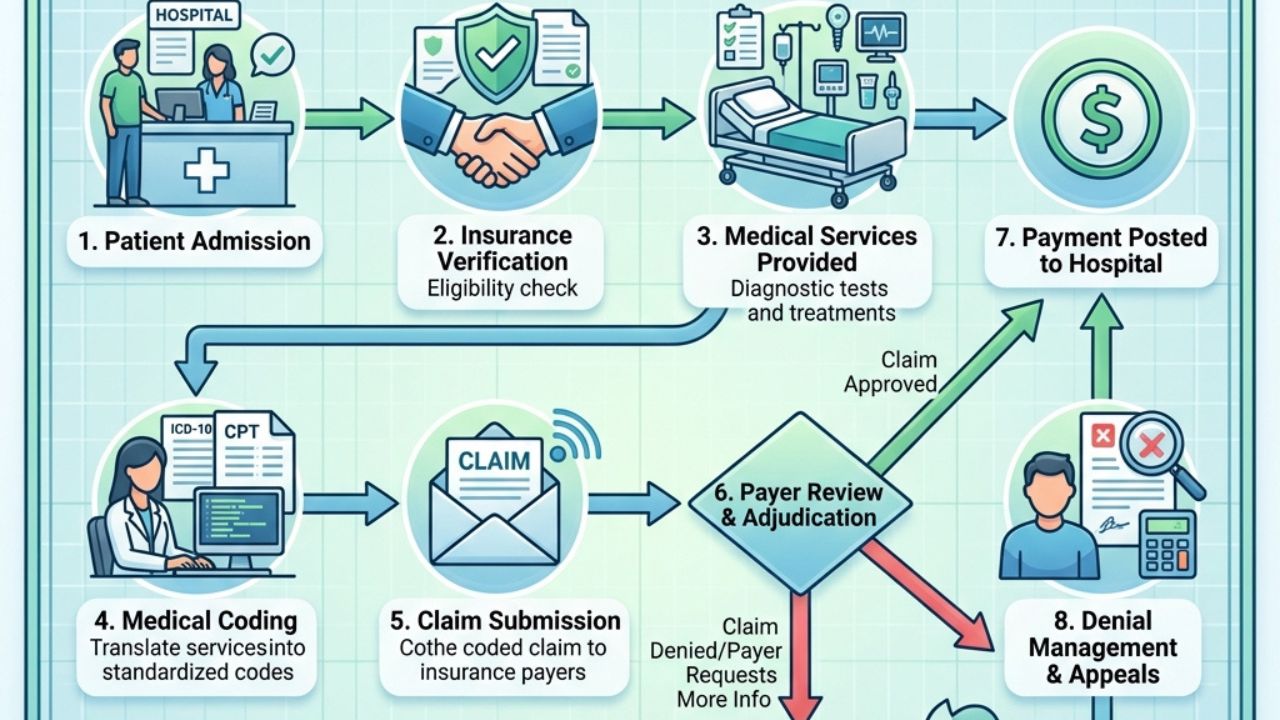
Hospital billing in the USA involves multiple steps—insurance verification before admission, medical coding during your stay, and claims submission after discharge. Understanding each phase helps you spot errors, avoid surprise bills, and negotiate costs more effectively.
Getting a hospital bill shouldn’t feel like decoding a foreign language. Yet for millions of Americans, that’s exactly what it feels like. A single overnight stay can generate multiple bills from different providers, each packed with cryptic codes, unfamiliar terms, and charges that seem to appear out of nowhere.
The US healthcare billing system is widely regarded as one of the most complex in the world. Unlike single-payer systems found in countries like Canada or the UK, the American model involves a web of private insurers, government programs like Medicare and Medicaid, hospital billing departments, and third-party administrators—all interacting simultaneously. The result? A process that’s confusing even for healthcare professionals.
But here’s the thing: understanding how hospital billing works isn’t just an academic exercise. Medical billing errors are surprisingly common. According to a study published in the Journal of the American Medical Association (JAMA), billing inaccuracies affect a significant portion of hospital claims. Catching these errors—or knowing when a charge looks suspicious—can save you hundreds or even thousands of dollars.
This guide walks you through the entire billing journey, from the moment you’re admitted to the day you receive your statement. By the end, you’ll know exactly what each phase involves, what to watch out for, and how to advocate for yourself when the bills start arriving.
The Journey of a Hospital Bill: From Admission to Statement
Hospital billing doesn’t happen all at once. It unfolds in stages, each with its own processes, players, and potential pitfalls. Here’s how it all breaks down.
What Happens During Pre-Admission and Insurance Verification?
Before you receive a single treatment, your hospital’s billing team gets to work. The pre-admission phase is largely administrative, but it sets the financial tone for everything that follows.
Insurance verification is the first step. Hospital staff confirm your coverage with your insurer to determine what services are covered, at what rate, and under what conditions. This process also establishes whether you’re receiving care in-network or out-of-network—a distinction that can dramatically affect your final bill.
For non-emergency procedures, hospitals typically require prior authorization (also called pre-authorization). This is your insurer’s formal approval for a specific treatment or service. Without it, your insurer may deny the claim entirely, leaving you responsible for the full cost. Always confirm that any planned procedure has been pre-authorized before you’re admitted.
Understanding your policy terms is equally important at this stage. Three figures shape how much you’ll ultimately pay:
- Deductible: The amount you pay out-of-pocket before your insurance starts covering costs. For example, if your deductible is $2,000, you cover the first $2,000 of eligible expenses each plan year.
- Co-pay or co-insurance: Your share of the cost after the deductible is met. Co-pays are fixed amounts (e.g., $50 per visit), while co-insurance is a percentage (e.g., you pay 20%, your insurer pays 80%).
- Out-of-pocket maximum: The cap on what you’ll pay in a given plan year. Once you hit this limit, your insurer covers 100% of covered services.
Knowing these numbers before you’re admitted gives you a clearer picture of your potential financial exposure.
How Are Services Documented and Coded During Your Hospital Stay?
Once you’re admitted, every service, medication, procedure, and supply used during your stay gets documented and assigned a code. This medical coding process is the backbone of hospital billing—and it’s where many errors occur.
Medical coding systems used in US hospitals include three main frameworks:
- ICD-10 (International Classification of Diseases, 10th Revision): These codes describe your diagnosis. For example, a code might specify not just “pneumonia,” but the specific type and its underlying cause. There are over 70,000 ICD-10 codes in use.
- CPT (Current Procedural Terminology): Developed by the American Medical Association, CPT codes describe the specific procedures performed—everything from an X-ray to a complex surgical procedure.
- HCPCS (Healthcare Common Procedure Coding System): This system covers services, supplies, and equipment not included in CPT codes, such as ambulance services or durable medical equipment like crutches.
Coders must translate clinical documentation from physicians and nurses into the correct combination of these codes. A single missed or incorrect code can result in a denied claim or an inflated bill.
What gets charged during a hospital stay? More than most patients realize. Hospital charges typically include:
- Room and board: Daily charges for your bed, nursing care, and basic monitoring. Intensive care units (ICUs) command significantly higher daily rates than standard rooms.
- Procedures: Each diagnostic test, surgical procedure, or therapeutic intervention carries its own charge. A basic blood test and a CT scan will appear as separate line items.
- Medications: Every drug administered—including over-the-counter items like acetaminophen—is logged and billed. Hospital medication charges are frequently cited as some of the most inflated line items on a bill.
- Supplies: Gloves, syringes, bandages, and other disposable items are billed individually.
Physician fees vs. hospital fees is a distinction many patients don’t realize until the bills arrive. The hospital bill covers the facility and its resources. But the physicians who treated you—your surgeon, anesthesiologist, radiologist, or consulting specialist—typically bill separately through their own practices. This means a single hospital stay can generate multiple bills from multiple providers.
This is also why out-of-network surprises are so common. Your hospital may be in-network, but an anesthesiologist or emergency room physician who treated you may not be. The No Surprises Act, which took effect in January 2022, offers some federal protections against unexpected out-of-network charges, particularly in emergency situations—but understanding your coverage in advance remains the best defense.
What Happens After Discharge: How Do Hospitals Submit Claims?
After you’re discharged, the hospital’s billing department consolidates all charges, assigns final codes, and prepares a claim for submission to your insurer. This post-discharge phase is where the financial machinery really kicks into gear.
The hospital’s billing department is responsible for ensuring that every service rendered is accurately documented and coded before the claim goes out. Large hospitals often employ entire teams of medical coders, billing specialists, and compliance officers to manage this process. Errors at this stage—whether a duplicate charge, an incorrect code, or a missing modifier—can delay payment or result in a denied claim.
Electronic claims submission is now the standard in US healthcare billing. Hospitals submit claims digitally to insurers using standardized formats (typically the ANSI X12 837 format), which allows for faster processing and tracking than paper-based systems. Most claims are processed within 30 to 45 days, though complex cases or disputes can take considerably longer.
Once the insurer receives and processes the claim, they send back an Explanation of Benefits (EOB). This document is critically important—and frequently misunderstood. An EOB is not a bill. It’s a summary that shows:
- What services were billed
- What the insurer covered
- What adjustments were made (e.g., negotiated rate discounts)
- What portion you’re responsible for paying
Review your EOB carefully and compare it against any itemized bill you receive from the hospital. Discrepancies between the two are worth questioning. You have the right to request an itemized bill from any hospital, and doing so is one of the most effective ways to identify billing errors.
Common Hospital Billing Errors to Watch Out For
Billing mistakes are more prevalent than the industry likes to admit. Common errors include:
- Duplicate charges: The same service billed twice
- Upcoding: A procedure coded at a higher complexity level than what was actually performed
- Unbundling: Billing separately for procedures that should be packaged together at a lower rate
- Charges for services not rendered: Particularly common with medications or supplies
If you spot a potential error, contact the hospital’s billing department directly. Most hospitals have a patient advocate or financial counselor who can walk through the bill with you. If the issue isn’t resolved internally, you can file a complaint with your state’s insurance commissioner or, for Medicare/Medicaid claims, with the Centers for Medicare & Medicaid Services (CMS).
What to Do If You Can’t Afford Your Hospital Bill
Receiving a large hospital bill doesn’t mean you have to pay the full amount upfront—or at all, in some cases. Options worth exploring include:
- Financial assistance programs: Most nonprofit hospitals are required by the IRS to offer charity care programs. Eligibility is typically based on income relative to the federal poverty level.
- Payment plans: Hospitals routinely offer installment arrangements. Interest-free plans are often available if you ask.
- Negotiation: The listed price on a hospital bill is rarely the final price. Patients who pay out-of-pocket can often negotiate a reduced rate, particularly if they can pay a lump sum.
- Medical billing advocates: These professionals review bills on your behalf, identify errors, and negotiate with providers. They typically work on a contingency basis, taking a percentage of whatever they save you.
Take Control of Your Hospital Bills
Hospital billing in the USA is complex by design—but that doesn’t mean you’re powerless. The more you understand about how charges are generated, coded, and submitted, the better equipped you are to review your bills critically and push back when something doesn’t add up.
Start by always requesting an itemized bill. Review your Explanation of Benefits before paying anything. Know your insurance terms before you’re admitted, not after. And if a bill seems wrong, question it—because often, it is.
Medical debt is the leading cause of personal bankruptcy in the United States, according to research published in the American Journal of Public Health. The good news? Many of those bills contain errors that a closer look would catch.
Frequently Asked Questions About Hospital Billing in the USA
Why did I receive multiple bills from one hospital stay?
Hospitals bill for facility services separately from physician services. Your surgeon, anesthesiologist, radiologist, and any specialist who treated you will each bill independently, even if they treated you within the same hospital.
What is an Explanation of Benefits (EOB), and is it the same as a bill?
An EOB is a document from your insurance company explaining how a claim was processed—what was covered, what was adjusted, and what you owe. It is not a bill. Wait for an actual bill from the hospital before making any payment.
How can I find out if my hospital bill contains errors?
Request a fully itemized bill from the hospital. Cross-reference each line item against your EOB and the services you recall receiving. Look for duplicate charges, unfamiliar codes, or items like medications you weren’t given. A medical billing advocate can also review your bill professionally.
What is prior authorization, and what happens if I don’t get it?
Prior authorization is advance approval from your insurer for a specific service or procedure. Without it, your insurer may deny the claim, leaving you responsible for the full cost. Always confirm authorization before any planned hospital procedure.
Can I negotiate a hospital bill after I’ve already been discharged?
Yes. Hospitals negotiate bills regularly. If you’re paying out-of-pocket or the bill is beyond your means, contact the billing department directly. Ask about financial assistance programs, interest-free payment plans, or a reduced lump-sum settlement.
What federal protections exist against surprise medical bills?
The No Surprises Act, effective January 1, 2022, limits surprise billing for emergency services and certain non-emergency services at in-network facilities. It caps out-of-network cost-sharing at in-network rates in qualifying situations and requires providers to give good-faith cost estimates before scheduled services.